

You and your corporate have started this amazing start-up, amazing idea – this is going to be the next big thing, the thing that has the potential to be +10% of total revenue for the corporate, the idea that will propel the value of your corporate to the next level and the idea that will grow a whole new customer segment with higher profitability. This… is… amazing! Everything is good!
Your corporate will be there for you every step of the way. Does the start-up need marketing support? “No problem – we will allocate some from the marketing team”. Does the start-up need to build with top-notch tech resources and software licenses? “No problem, we have been doing that for years, we will give you a turn-key solution”. Does your start-up need a go-to-market plan? “No problem, we have several proven go-to-market models and key people to run them for you!” I can go on…
You see – this is all with the very best of intentions – and some of these might actually work individually. However, the sum of just a few of these is enough to introduce the concept of ‘hugging to death’ – overwhelming you start-up with good intentions. We love you so much, that you will get everything we have and in turn, transforming the corporate start-up into a corporate project. Expose the start-up to corporate processes and corporate culture. If the reasons for starting as a corporate start-up were sound, then you have also effectively reduced chance of success to zero! You have stifled your entrepreneurs! Congratulations, you have hugged your start-up to death – and in the end, you will have no choice but to argue that the idea wasn’t as great as we thought and close it down – move on.
(even though it was your hug that ultimately saw the end of it)
So how do you avoid this ‘hug of death’?
Simple answer: Dont start corporate start-ups, just do corporate projects supporting the core and creating incremental growth. More complicated answer (hint: the right one): Build an environment that will support and nurture corporate start-ups in the right blend of ‘support & grown on your own’.
For the simple answer: Just dont do corporate start-ups
This is a great way to slowly and securely allow your corporate to become prey of young and hungry new-comers. Perhaps not in 2 or 3 years or on the watch of the current CEO – but it is happening. It is ‘corporate complacency’ in the works. It is a diligent focus on core revenue streams, core customer segments and the result of the next quarterly report. It is a function of short term optimisation and a long term hope. Hope that nobody else will create disruptive innovation within your industry. You look great right now, but look foolish in the future.
#nokia #Myspace #Qwest #Netscape #Blackberry #Motorola #Kodak
For the more complicated answer: Build an environment that will support and nurture corporate start-ups
As a corporate, you have some initial (huge) key advantages that no start-up will ever come close (customers, networks, market access, capital etc). If you are able to systematically master these advantages whilst avoiding the apparent disadvantages you will be able to create one of the strongest and best corporates of the world! And it won’t just be a fluke – it will be sustainable and ensure that your corporate will be ever-evolving, even on core revenue streams. Imagine that!
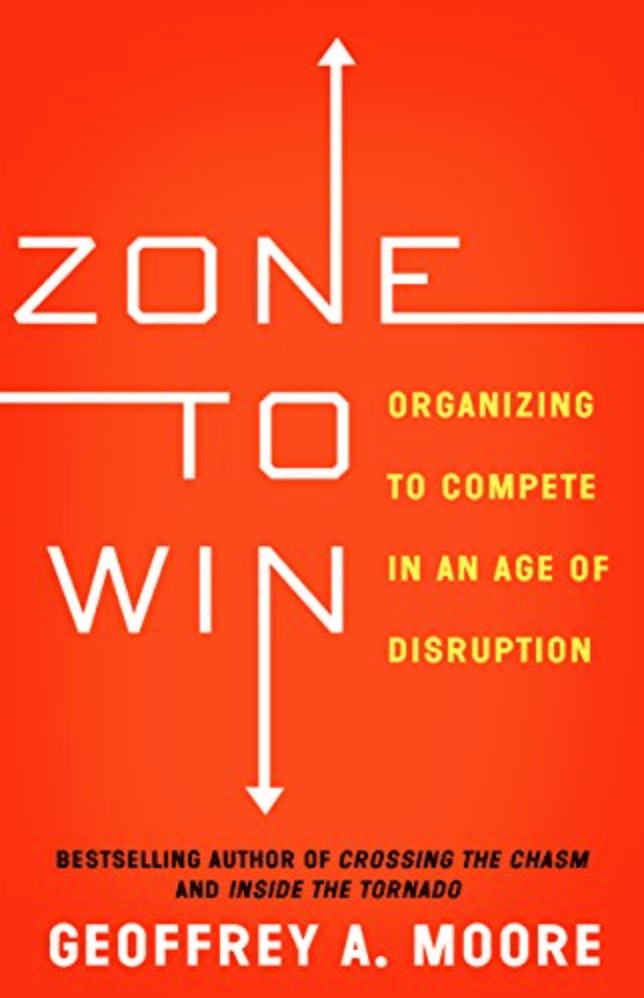
In 2016, when I was asked to be responsible for building a corporate start-up (Twill), I (and we) knew little about what kind of environment the corporate needed to create to maximise chance of success for the corporate start-up. So over the last 3 years we have experimented a lot, failed a lot, succeeded a lot, learned a lot – and collected inspiration from others + academia. It is in this capacity I aim to share my view on a rather simple approach to creating the environment for success. Well, actually, it is not my approach. I have found that the simplest and cleanest way to structure and explain the necessary steps is well covered by Moore in his book ‘zone to win’. So I will wrap my learnings in his elegant model rather than try to reinvent the wheel.
As a general way of running a successful business that keeps growing in reinventing itself, Moore suggests dividing your organisation in 4 different zones. Each with different management structure, capabilities and success criteria – however 4 zones that needs to work closely together. For this blog I will zoom in on the zone called ‘Incubation Zone’ and refer the reader to the book for details on the remaining 3 zones.
“The Incubation Zone”
The incubation zone is where a corporate hosts its long term bets that all has the potential to grow to a minimum of 10% of total corporate revenue in 10yrs and 1-2% in 4-5 years (If smaller potential, they are not relevant no matter the total revenue of your corporate). Each of these bets are called an IOU – Independent Operating Unit. These are not corporate projects or research experiments – each IOU is a new company and should be run as such. Using the model below, let me try explain the concept in a few simple bullets:

- The Incubation zone is governed by its own ‘venture board’. This board decides where innovation is needed and hence which IOU gets funded and follow-up funded. The venture board has its own Incubation Fund and basically lets the IOUs compete amongst each other to get funded (you know – like a normal start-up). The venture board should include the corporate CEO, Head of Incubation Zone, a few other relevant execs as well as external representation to ensure balance between venture capital thinking and publicly held corporation thinking (the last bit is my addition to the concept Moore describes)
- Each IOU is not part of the normal financial calendar of the corporate – it is simply not a process fit for purpose. As an example, just think of a start-up that should have been shut down after 3 months but keep going for 12 months because it is funded per fiscal year #whatawaste. An IOU is treated like a start-up where funds are allocated in rounds (Seed, A, B, C, etc), each with clear expectations of targets to achieve. This also means, that if the corporate needs to find short-term cash it cannot be done by reducing the already allocated funds to an IOU!
- An IOU has its own general management as well as needed dedicated ressources to run and grow the start-up (e.g. product dev, engineers, marketing, go-to-market, sales etc). Ressources should never be shared across IOUs or from the corporate – it will end up in prioritisation issues, half-hearted attempts, confused employees and will end badly.
- The portfolio of IOUs is supported by a small team representing various corporate services (e.g. HR, Finance, Legal etc) to ensure fit-for-purpose cooperation. The team is tasked with bridging the gap between start-up needs and the corporate cadence and hence ensuring the the IOUs dont get trapped in corporate processes.
- “Investing in disruptive innovation is a Darwinian exercise – it should be hard to get funded and hard to stay funded” (Moore). If an IOU doesn’t live up the expectations (more than once) it should be closed down as ressources in the incubation zone are too valuable to waste. With enough IOUs it may be relevant to have a person or a unit responsible for ensuring no ressources are wasted (and end-of-life unit). Further, it is never a possibility for an IOU to stay in the incubation zone – you either make it big or go out in the process. There are many ways to ‘go out’, including assimilated into existing business line, spun out but keep an ownership share or sell the business to someone who can better capitalise (the latter is seldomly seen unfortunately)
With above mentioned all done, the next step is to ensure you pick the right leadership for an IOU. Here is a point I cannot stress enough: You need a gutsy and entrepreneurial CEO for each IOU. A common mistake is to pick a long career executive that are not used to rolling up their sleeves nor is willing to push the system enough to get things done. If you pick the long term career exec – you are just not going for the true disruptive innovation.
If you find this blog an interesting read then I highly recommend you to read the book ‘Zone to Win’ by Geoffrey A. Moore for more detailed understanding. It is an easy read and great to bring on e.g. a short flight.
 My playground for the mind